
Malcolm Gladwell just spent two full episodes of Revisionist History on my city. Not the Baltimore of the headlines. Not the punchline. The Baltimore that went from 350 homicides to under 100 in the space of three years.
"350 homicides to under 100 in the space of three years. An astonishing transformation."
-- Malcolm Gladwell
I have lived in a lot of places. I came to this country with nothing and started from the bottom, and I chose Baltimore. I raise my two kids here. They go to Baltimore public schools. I sell homes here, I walk these blocks, I know these neighborhoods the way you only know a place when it is yours. So when someone like Gladwell points a microphone at this city and says, look at what happened here, I feel it personally.
Here is what happened, in numbers.
In 2019, Baltimore recorded about 350 homicides. We were called America's murder capital, and nobody argued. Seven straight years above 300. Then something shifted. The city closed 2025 with 133 homicides, the lowest total in roughly fifty years. And 2026 is on pace to come in under 100 for the first time since the mid-1960s. Midway through this year, our homicide rate sat 68 percent below 2019 levels, one of the steepest drops of any city in America. This past July saw seven homicides, the first single-digit July in about twenty-five years.
Read that again. Seven. In July. In Baltimore.
Gladwell's first episode, Wolfgang's Law Part One, released October 8, opens with exactly this: "a city once labeled America's murder capital seeing a reprieve that seems nothing short of miraculous." His question is the right one. What happened?
The honest answer is that Baltimore tried, failed, and tried again. The strategy behind the turnaround is called the Group Violence Reduction Strategy, launched in early 2022. The idea behind it is called focused deterrence: find the small number of people most likely to be involved in shootings, and offer them real help paired with real consequences. Here is the part nobody talks about. Baltimore tried versions of this in the 1990s. It fizzled. Tried again in 2014. It fizzled. Mayor Brandon Scott proposed trying a third time in 2021, and people were tired. Community meetings were empty. Residents had heard it all before.
They did it anyway. And this time it held.
Part Two, released October 15, asks the harder question:
"We've known about a solution to violent crime for decades. Why hasn't it been adopted everywhere? And what are the costs of waiting so long?"
-- Malcolm Gladwell, Wolfgang's Law Part Two
Those are not abstract questions. Every year of waiting was measured in lives on blocks I drive past every week.
I want to say something as someone who chose this city when I could have chosen anywhere. Baltimore never needed saving by outsiders. It needed what it finally gave itself: patience, follow-through, and the humility to try a third time. The police clearance rate for homicides hit 60 percent in the first half of this year. Community violence-interruption programs, the ones that stop conflicts before they turn deadly, are part of the daily strategy now, not an afterthought. This was not one hero and one policy. It was a city deciding, block by block, that the old story was over.
And here is what moves me most. For years, the national story about Baltimore was written by people who do not live here. Now the national story is being rewritten, and the people writing it are studying us. The city everybody wrote off is now the city everybody studies. Gladwell did not come here to pity Baltimore. He came because Baltimore figured something out that the rest of the country needs to learn.
I sell homes in this city. I tell buyers about the rowhouses, the porches, the neighborhoods with real character and prices that still make sense. But what I am really selling, if I am honest, is belief. Belief that this city is going somewhere. Now I have two episodes of proof from one of the most listened-to storytellers in America.
If you have not listened yet, the episodes are Wolfgang's Law, Part One and Part Two, Season 12 of Revisionist History. Listen to them. Then come walk these streets with me and see the miracle for yourself.
FROM OUR BLOG
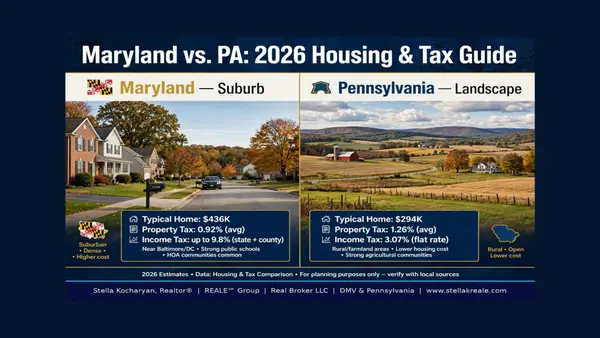
Top Neighborhoods to Live in Maryland and the DMV Area
Top Neighborhoods to Live in Maryland and the DMV Area Are you considering a move to Maryland or the DMV area? The region offers a diverse array of neighborhoods that cater to every lifestyle. From the vibrant streets of Bethesda to the historic charm of Georgetown, there’s something for everyone. B
Essential Tips for Moving to Maryland and the DMV
Essential Tips for Moving to Maryland and the DMV Moving to a new area is exciting, but it comes with challenges. Maryland and the DMV offer a dynamic mix of urban, suburban, and rural communities. Here’s what you should know before making the move: Understand the Cost of Living The cost of living v
Meet the Top Real Estate Agents in Maryland and the DMV
Meet the Top Real Estate Agents in Maryland and the DMV Choosing the right real estate agent is crucial for a successful home buying or selling experience. In Maryland and the DMV, several agents stand out for their expertise and commitment to clients. Stella Kocharyan – REALE Group With deep local